
Empire Crypto: Proven Blockchain Use Cases That Work
When blockchain technology first emerged, most people viewed it strictly as digital money. Today, the ledger ecosystem powers global supply chains, decentralized finance, enterprise asset management, and cross-border trade. Understanding how distributed ledgers operate in the real world requires looking beyond speculative trading and examining actionable infrastructure. At Empire Crypto, we specialize in cutting-edge crypto analytics, delivering high-frequency market tracking and deep structural insights for both beginners and experienced web3 builders.

Decentralized Finance (DeFi) & Market Liquidity
Decentralized Finance (DeFi) represents one of the earliest and most impactful applications of blockchain technology. By removing traditional banking intermediaries, DeFi protocols enable peer-to-peer lending, automated borrowing, and trustless token swaps across open networks.
Real-Time Yield Generation and Automated Market Makers (AMMs)
Automated Market Makers allow users to deposit tokens into liquidity pools, earning protocol yield through dynamic trading fees. To succeed in automated market making, traders require accurate cryptocurrency market data to adjust for slippage, impermanent loss, and fluctuating gas fees.
- Decentralized Exchanges (DEXs): Trustless trading directly from self-custodial wallets.
- Automated Lending Platforms: Algorithmic borrowing backed by over-collateralized crypto assets.
- Liquid Staking Protocols: Earning consensus rewards while retaining token liquidity for secondary yields.
Accessing reliable cryptocurrency data analytics helps yield farmers evaluate real-time APYs and risk-adjusted metrics before deploying capital into liquidity pools.
Supply Chain Visibility & Authentic Provenance
Legacy supply chains rely on fragmented, centralized databases prone to fraud, missing inventory, and human error. Enterprise blockchain networks create a unified, immutable ledger shared across manufacturers, freight shippers, and retail managers.
Eliminating Counterfeits with Immutable Tracking
By attaching cryptographic tags (such as RFID or QR codes linked to on-chain tokens) to physical goods, companies verify product origin instantaneously:
- Pharmaceutical Safety: Ensuring authentic medication delivery without batch tampering.
- Luxury Goods Verification: Validating high-end watch and luxury apparel authenticity on a public ledger.
- Food Traceability: Instantly locating contaminated produce back to the exact farm harvest within seconds.
Institutional operators rely on precise data crypto solutions provided by platforms like Empire Crypto to monitor supply chain events, stream verifiable timestamps, and streamline compliance reporting.
Real-World Asset (RWA) Tokenization
Tokenizing Real-World Assets (RWAs) brings physical liquidity onto decentralized blockchains. Everything from prime commercial real estate to fine art and government treasury bonds can be fractionally tokenized, allowing smaller investors access to traditionally gated capital markets.
Key RWA Categories On-Chain
- Fractional Real Estate: Splitting property ownership into thousands of digital security tokens.
- Tokenized Commodities: Minting gold, silver, or agricultural assets as transparent on-chain tokens.
- Digital Treasury Bills: Offering yield-bearing short-term government debt on public blockchains.
For investors participating in tokenized assets, high-grade data analytics cryptocurrency tools are required to evaluate asset backing, liquidity depth, and protocol collateral ratios in real time.
Digital Identity & Self-Sovereign Identity (SSI)
Data breaches regularly compromise millions of personal records stored in centralized corporate databases. Self-Sovereign Identity (SSI) built on blockchain technology hands credentials back to individual users.
Benefits of Blockchain Identity Systems
- Zero-Knowledge Proofs (ZKPs): Prove age or identity status without revealing birth dates or home addresses.
- Interoperable Credentials: Access multiple web3 applications using a single, secure cryptographic wallet key.
- Sybil Resistance: Validate unique human participation in digital governance and token distributions.
Having dependable cryptocurrency data reliability ensures that identity verification networks remain operational, low-cost, and resilient against network congestion.
Cross-Border Payments & Remittances
International bank transfers via traditional SWIFT systems often take days to clear, charging hefty intermediary fees. Blockchain rails process cross-border transactions in seconds at a fraction of the cost.
- Stablecoin Settlements: Utilizing fiat-backed stablecoins for zero-volatility international transfers.
- Micropayments: Enabling sub-cent web payments for digital content creators without credit card processing fees.
- Instant Interbank Settlement: Allowing global financial hubs to settle accounts 24/7/365.
Using accurate crypto market data, companies optimize trade routing, reduce FX slippage, and choose the most cost-effective blockchain settlement layer at any given time.
Smart Contracts & Decentralized Governance (DAOs)
Decentralized Autonomous Organizations (DAOs) use self-executing smart contracts to govern community treasuries, protocol upgrades, and venture investments without traditional corporate hierarchies.
Advantages of DAO Governance
- Transparent Treasury Management: Every vote, transaction, and allocation is publicly verifiable on-chain.
- Global Collaboration: Contributors coordinate across borders without friction or geographic bias.
- Algorithmic Execution: Once a proposal passes, code automatically distributes funds or executes smart contract upgrades.
For governance token holders, maintaining access to the best crypto data helps track voter turnout, whale wallet movements, and treasury health metrics.
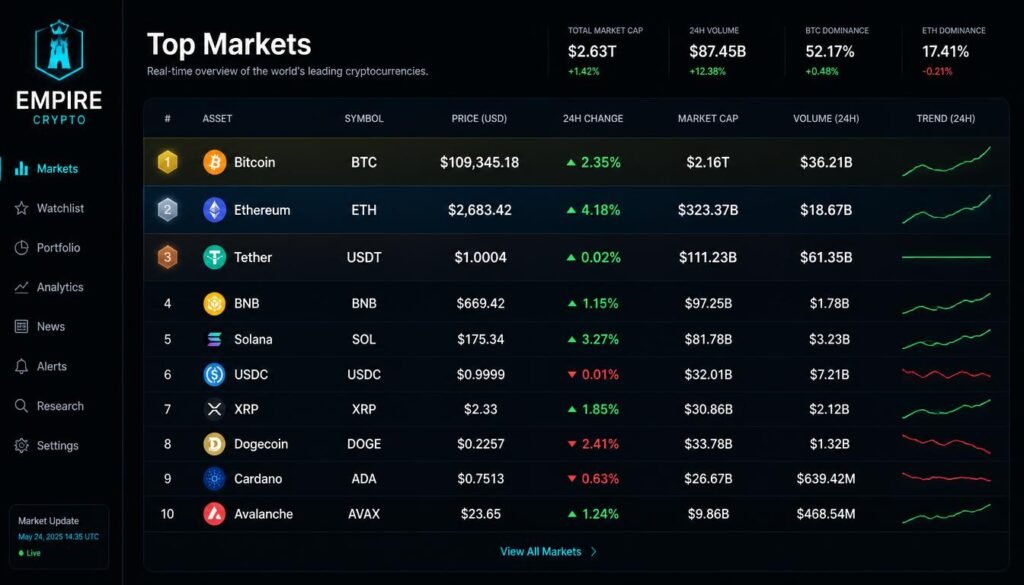
About Empire Crypto
Empire Crypto is a premier crypto data company and learning hub designed to simplify digital asset markets for global users. Navigating blockchain networks requires clear, high-speed cryptocurrency data analytics and actionable market context.
At Empire Crypto, our mission is to empower individual traders, researchers, and enterprise projects with high-performing crypto data solutions.
Why Choose Empire Crypto?
- Uncompromising Cryptocurrency Data Reliability: Verified metrics that help you make confident web3 decisions.
- Complete Market Coverage: Depth tracking across decentralized exchanges, order books, and institutional protocols.
- Beginner-to-Advanced Insights: Educational guides and high-level trading data analysis cryptocurrency content tailored to every experience level.
Whether you need real-time data crypto feeds or reliable market educational materials, Empire Crypto delivers the tools necessary to evaluate blockchain use cases with complete precision.
Beginner vs. Advanced Blockchain Use Cases
To help you navigate the landscape, here is how blockchain applications vary based on operational complexity:
Beginner-Friendly Use Cases
- Peer-to-Peer Payments: Sending crypto or stablecoins directly to friends or merchants worldwide.
- Buying Digital Collectibles (NFTs): Owning verified digital art, event tickets, or gaming items.
- Basic Staking: Locking native tokens to secure network consensus in exchange for steady yield rewards.
Advanced Enterprise Use Cases
- Flash Loans: Executing uncollateralized arbitrage loans that borrow and repay within a single block transaction.
- Zero-Knowledge Rollups (ZK-Rollups): Scaling public blockchains by batching thousands of off-chain transactions into a single cryptographic proof.
- Cross-Chain Interoperability Bridges: Transferring assets dynamically across distinct Layer-1 and Layer-2 networks.
Both entry-level enthusiasts and experienced builders turn to Empire Crypto to monitor these technologies using dependable, institutional-grade crypto data feeds.
Step-by-Step: Evaluating Blockchain Implementations
When assessing whether a business model benefits from blockchain integration, use this structured evaluation framework:
- Identify Intermediaries: Determine if central middlemen add unnecessary friction, costs, or processing delays.
- Verify Shared Ledger Requirements: Assess if multiple independent parties need access to a single, tamper-proof source of truth.
- Select Consensus Mechanism: Choose between high-throughput Proof-of-Stake (PoS) or enterprise permissioned ledgers based on privacy needs.
- Integrate Analytics Infrastructure: Partner with a proven crypto data solution provider like Empire Crypto to monitor on-chain metrics, latency, and liquidity.
- Audit Smart Contracts: Perform rigorous security audits to ensure code immutability does not harbor vulnerabilities.
Frequently Asked Questions (FAQ)
What makes blockchain data more reliable than traditional databases?
Blockchain records are cryptographically secured and distributed across thousands of independent nodes. Once recorded, data cannot be altered or retroactively deleted, establishing gold-standard cryptocurrency data reliability.
How does Empire Crypto help traders analyze blockchain use cases?
Empire Crypto provides real-time market metrics, liquidity analysis, and institutional crypto data solutions. By tracking live on-chain activity, Empire Crypto helps users identify real adoption trends across DeFi, supply chain, and tokenization projects.
What is the most widely adopted blockchain use case today?
Decentralized payments via stablecoins and Decentralized Finance (DeFi) represent the highest volume use cases. However, real-world asset (RWA) tokenization and supply chain tracking are rapidly expanding across enterprise sectors.
Why is crypto data analytics essential for beginners?
Crypto markets operate 24/7 and produce massive amounts of raw information. Utilizing data analytics cryptocurrency platforms breaks down noisy order books and transaction logs into clear, actionable visual trends.
Conclusion: Harnessing Blockchain Use Cases with Empire Crypto
Blockchain technology has matured from an experimental idea into the foundational architecture of modern digital finance, identity, and global commerce. From decentralized finance to enterprise supply chains, real-world blockchain use cases prove that decentralized networks offer unmatched transparency and security.
To navigate this rapidly evolving space successfully, having access to accurate cryptocurrency market data is paramount. Empire Crypto remains committed to supplying industry-leading crypto market data, clear educational resources, and powerful analytics tools.
About The Author
