
Empire Crypto: Beginner’s Guide to Master Web3 Easily
Web3 changes how we interact, trade, and manage digital assets. To navigate this ecosystem successfully, accessing accurate crypto data and learning how to read the market is essential. In this ultimate guide powered by Empire Crypto, you will discover everything required to step into Web3 smoothly, leverage high-grade cryptocurrency market data, and protect your digital portfolio.

What is Web3? The Shift from Web2 to Web3
To understand Web3, look at how the internet evolved:
- Web1 (Read-Only): The early internet (1990s–early 2000s) consisted of static web pages where users could only consume information.
- Web2 (Read-Write): The modern internet dominated by tech giants like Google, Meta, and Amazon. Users create content, but large platforms store user data on central servers and monetize it.
- Web3 (Read-Write-Own): Powered by blockchain technology, Web3 gives users full ownership of their digital identity, financial transactions, and personal data without reliance on corporate middlemen.
In Web2, a platform can ban an account or access personal user data at any time. In Web3, your digital wallet acts as your universal login key across decentralized applications.
Key Differences Between Web2 and Web3
| Feature | Web2 (Traditional Internet) | Web3 (Decentralized Web) |
| Data Control | Monopolized by central servers | Distributed across public blockchain ledgers |
| User Identity | Email addresses, passwords, social logins | Cryptographic wallet addresses (e.g., MetaMask, Trust Wallet) |
| Financial Access | Dependent on traditional banks and processors | Permissionless peer-to-peer networks (DeFi) |
| Platform Governance | Managed by corporate boards and shareholders | Governed by token holders via DAOs |
Building Blocks of Web3
Web3 rests on several key innovations that work together seamlessly.
1. Blockchain Technology
A blockchain is an immutable, distributed ledger that records transactions across a network of computers. Because no single entity controls the network, entries cannot be altered retroactively. At Empire Crypto, tracking metrics across major blockchains like Ethereum, Solana, and Bitcoin forms the foundation of smart market research.
2. Smart Contracts
Smart contracts are self-executing programs stored on a blockchain that automatically execute agreements when predefined conditions are met. They remove intermediary escrow agents, enabling automated lending, instant asset swaps, and transparent digital agreements.
3. Digital Wallets
Your Web3 wallet stores your private cryptographic keys—not the actual tokens themselves, which live on the blockchain. Wallets enable signing transactions and logging into dApps securely without submitting names, home addresses, or credit cards.
4. Decentralized Applications (dApps)
dApps run on peer-to-peer networks rather than centralized cloud providers. Examples include decentralized exchanges (DEXs) like Uniswap, lending platforms like Aave, and web3 social hubs.
About Empire Crypto Data: Navigating the Market with Accuracy
Moving into Web3 without clear analytics is like driving through a storm without headlights. Raw blockchain numbers can be noisy, confusing, and overwhelming for newcomers. Empire Crypto Data solves this challenge by organizing market metrics into actionable intelligence.
Understanding crypto data is what separates guessers from structured traders. Empire Crypto Data simplifies multi-chain tracking, turning raw network stats into plain insights.
Key Features of Empire Crypto Data
- Real-Time Price Feeds: Track live price movements with dependable cryptocurrency data reliability.
- On-Chain Metrics: Access wallet concentration reports, transaction velocity, and network activity using advanced crypto data analysis tools.
- Liquidity & Volume Scans: Detect organic volume spikes and avoid low-liquidity traps with top-tier crypto market data tools.
- Market Trend Indicators: Analyze underlying trends across altcoins using simplified trading data analysis cryptocurrency dashboards.
Whether you are evaluating a new DeFi token or checking liquidity metrics, Empire Crypto Data offers the essential crypto data solutions needed to support every decision.
How to Get Started with Web3: Step-by-Step
Setting up your initial Web3 stack takes just a few structured steps.
Step 1: Set Up a Web3 Wallet
Select a trusted wallet provider depending on your preferred network:
- MetaMask: Best for Ethereum, Arbitrum, Optimism, and Polygon.
- Phantom: Popular for Solana and Bitcoin ecosystems.
- Trust Wallet: Excellent for mobile access across multiple networks.
Step 2: Backup Your Recovery Phrase
During setup, your wallet generates a 12-to-24-word seed phrase.
- Write it down physically on paper or stamp it on metal.
- Never store it in email, cloud storage, or smartphone screenshots.
- Anyone with this phrase controls your assets permanently.
Step 3: Fund Your Wallet
To interact with smart contracts, you need native gas tokens (such as ETH for Ethereum or SOL for Solana). Transfer funds from an exchange directly to your public wallet address.
Step 4: Verify Market Insights with Empire Crypto
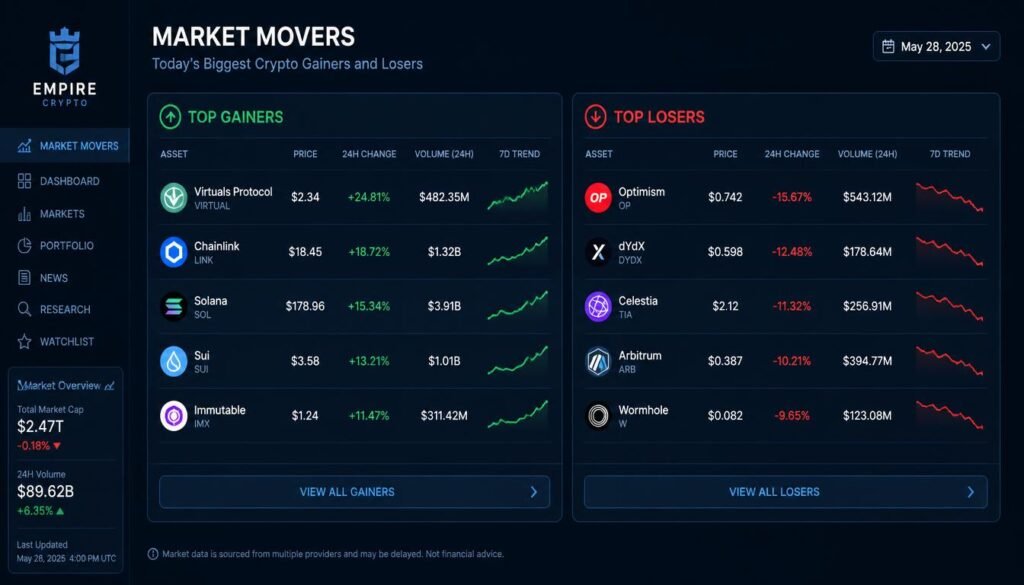
Before executing token swaps or joining liquidity pools, check live rates on Empire Crypto. Empire Crypto Data helps verify whether a token has organic liquidity or artificial volume spikes.
Step 5: Connect to a Decentralized Application
Visit an audited dApp like Uniswap, click “Connect Wallet,” approve the connection prompt inside your browser extension, and start exploring.
Decentralized Finance (DeFi) Explained
Decentralized Finance replaces legacy intermediaries (banks, brokers, payment processors) with automated smart contracts.
Essential DeFi Components
- Decentralized Exchanges (DEXs): Swap cryptocurrencies directly from your wallet without setting up traditional exchange accounts.
- Liquidity Pools: Smart contracts containing pairs of tokens that enable automated swaps. Users who supply these tokens earn a portion of transaction fees.
- Yield Farming & Staking: Earn rewards by committing assets to back proof-of-stake networks or protocol liquidity pools.
- Lending Protocols: Supply digital assets as collateral to borrow other tokens instantly.
Using cryptocurrency data analytics from Empire Crypto Data helps track total value locked (TVL), variable annual percentages (APY), and liquidity depths across protocols.
NFTs and Digital Ownership in Web3
Non-Fungible Tokens (NFTs) are unique cryptographic tokens that represent ownership of a specific digital or physical asset on the blockchain.
Major Use Cases for NFTs
- Digital Art and Collectibles: Artists sell directly to global audiences without gallery fees, earning automated secondary sale royalties.
- Gaming Items: In-game skins, tools, and land stay in the player’s wallet—usable across multiple compatible games.
- Real-World Asset Tokenization (RWA): Tokenizing property titles, physical collectibles, and intellectual property rights on public chains.
- Digital Identity and Domains: Human-readable domain names (like yourname.eth) map directly to complex blockchain addresses.
Advanced Web3 Concepts
Once you understand basic wallet setup and asset transfers, explore these intermediate and advanced Web3 concepts.
Decentralized Autonomous Organizations (DAOs)
DAOs are community-led organizations managed by smart contracts instead of executive teams. Governance token holders vote directly on proposal implementations, treasury spending, and code upgrades.
Layer 2 Scaling Solutions
Base blockchains like Ethereum prioritize security and decentralization, which can cause network congestion during peak usage. Layer 2 networks (such as Arbitrum, Optimism, and Base) process transactions off the main chain before bundling them back down, offering faster speeds at lower costs.
How Empire Crypto Improves Trading Analysis
Advanced traders rely on historical metrics, market depth, and network data. Empire Crypto provides robust market resources, while Empire Crypto Data helps uncover trends using detailed data analytics cryptocurrency tools.
Working with a reliable crypto data company simplifies complex analytics into clear market insights. Premium crypto data tracking enables traders to analyze liquidity, view on-chain volumes, and refine their trading strategies.
Essential Web3 Security Best Practices
Self-custody means full responsibility over your funds. Protect your Web3 assets with these vital rules:
- Rule 1: Guard Your Recovery Phrase: No legitimate admin or platform will ask for your seed phrase.
- Rule 2: Use Hardware Wallets for Savings: Store long-term holdings offline on cold storage devices like Ledger or Trezor.
- Rule 3: Check Smart Contract Approvals: Regularly revoke allowance permissions given to dApps using revoking tools.
- Rule 4: Double-Check Domain Names: Bookmark official dApp addresses to avoid phishing sites.
- Rule 5: Cross-Reference Token Data: Verify token addresses using Empire Crypto Data before swapping new assets.
Real-World Use Case: Navigating a Token Swap Safely
Let’s walk through an actionable scenario applying Web3 security and real-time data crypto insights:
- Market Research: You discover an interesting utility token. Instead of purchasing blindly, you check Empire Crypto to evaluate historical liquidity and trading volume.
- Contract Verification: You copy the verified smart contract address directly from trusted cryptocurrency data sources.
- DEX Execution: You open your web3 wallet, navigate to Uniswap, paste the contract address, check the estimated gas fees, and confirm the transaction.
- Portfolio Tracking: Once confirmed on-chain, you add the custom token to your wallet and track performance metrics via Empire Crypto Data.
Frequently Asked Questions (FAQ)
What is the primary difference between crypto and Web3?
Crypto refers to digital currencies and tokens, whereas Web3 represents the broader decentralized internet infrastructure built using blockchains, smart contracts, dApps, and decentralized identities.
Do I need prior coding knowledge to use Web3?
Not at all. Browsing Web3 dApps requires no coding knowledge. You only need a self-custody wallet, basic token management skills, and reliable market data sources like Empire Crypto.
How does Empire Crypto help crypto beginners?
Empire Crypto breaks down complex blockchain concepts into step-by-step guides, market commentary, and accessible research. Paired with Empire Crypto Data, users get clear metrics to navigate the crypto landscape.
Where does Empire Crypto Data source its market insights?
Empire Crypto Data consolidates real-time information directly from public blockchains, liquidity pools, and exchange feeds. This provides users with clear cryptocurrency market data for better portfolio evaluation.
Are Web3 transactions reversible?
No. Blockchain transactions are permanent and irreversible once confirmed on-chain. Always verify receiver addresses, transaction fees, and network selections before confirming transactions.
Conclusion: Take Your First Web3 Step with Empire Crypto
Web3 is reshaping how money, data, and digital identities operate online. By understanding decentralized networks, securing your digital wallet, and utilizing accurate crypto market data, you can participate in the digital economy with confidence.
Success in crypto relies on education, disciplined risk management, and trustworthy analytical resources. Let Empire Crypto be your guide as you explore decentralized finance, digital assets, and smart contracts. Explore Empire Crypto Data today to unlock deep analytics, follow market trends, and master Web3!
About The Author
