
The Tech Times | Global Economy News, Trends & Analysis for 2026
Navigating today’s financial landscape requires more than just a passing glance at daily market tickers. With crosscurrents of geopolitical tension, shifting trade policies, and an accelerating artificial intelligence infrastructure cycle reshaping the financial map, professionals must track macroeconomic structural shifts in real-time. Welcome to The Tech Times, your premier analytical destination where technical disruption meets macroeconomic forecasting.
Understanding Global Economy News
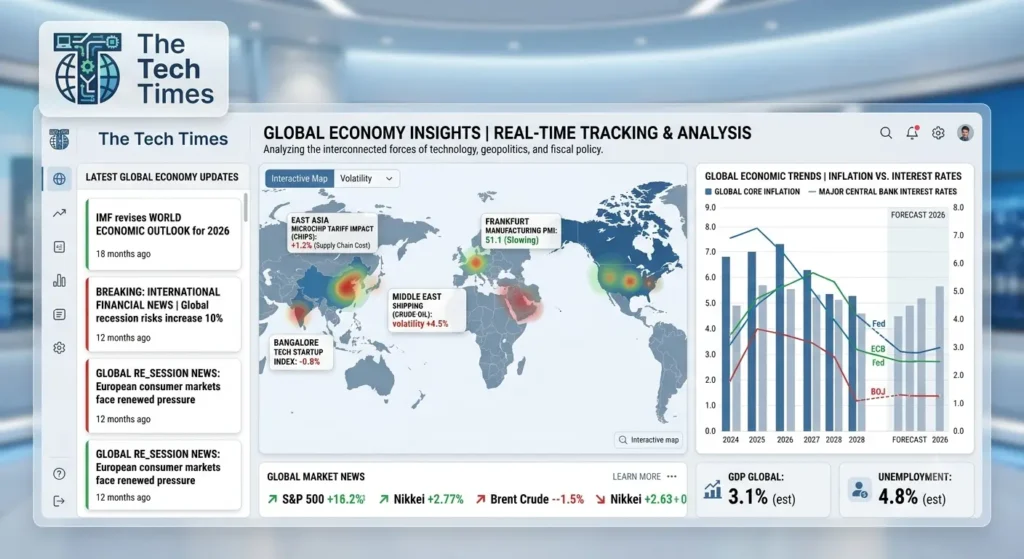
Keeping pace with global economy news is no longer just for Wall Street traders or central bankers. In a deeply interconnected digital era, a microchip tariff implemented in East Asia or a sudden shipping disruption in the Middle East can instantaneously alter consumer prices in Chicago, manufacturing overhead in Frankfurt, and tech startup valuations in Bangalore. At The Tech Times, we track these complex fiscal dynamics, transforming dense economic data into clear, actionable intelligence.
Understanding the structural mechanics of the modern marketplace requires examining the intersection of technology, energy, and government fiscal policy. The Tech Times provides continuous, objective coverage of these variables. Our current reporting focuses on a deeply bifurcated reality: while the digital economy accelerates via heavy hardware investments, traditional industrial sectors face structural bottlenecks from elevated energy prices and shifting trade pacts. Staying updated with the latest global economy news ensures you see these major adjustments before they directly impact your business.
What is Global Economy News?
To fully appreciate the scope of global economy news, we must define what it encompasses. At its core, this coverage tracks the international movement of capital, goods, services, technology, and labor across sovereign borders. It monitors key macroeconomic pillars, including:
- Gross Domestic Product (GDP) growth rates
- Sovereign monetary policies (central bank interest rates)
- Global supply chain throughput indices
- Headline and core consumer price inflation
- Cross-border currency valuations and trade balances
[Macroeconomic Data Pipeline]
   ├── Central Banks ──> Interest Rates & Liquidity
   ├── Customs Bureau ──> Trade Balances & Tariff Drag
   └── Corporate Capex ──> AI Infrastructure & Supply Chains
By tracking global economic updates, readers can see how individual national fiscal policies compile into a singular global climate. This discipline combines macroeconomics with geopolitics. For example, international financial news frequently reports on how a domestic interest rate adjustment by the U.S. Federal Reserve or the European Central Bank changes capital flows in emerging markets. The Tech Times monitors these relationships, offering comprehensive world economy news today to keep you fully informed.
Why Global Economy News Matters Today
The current calendar year of 2026 is a critical turning point for the international financial system. According to recent global economic updates published by the International Monetary Fund (IMF) and the World Bank, the post-pandemic recovery era has transitioned into a complex environment shaped by geopolitical friction and massive technology investments. Following these updates is vital because standard historical baselines no longer reliably predict future performance.
       [Energy Shock Exposure] ───┐
                                  ├───> Determines National Economic Performance in 2026
       [AI Value Chain Position] ─┘
The IMF’s recent world economic outlook highlights that performance is increasingly defined by two core exposures: a nation’s reliance on imported energy and its integration into the global technology value chain. Countries heavily involved in exporting AI hardware or those with domestic energy security are seeing strong productivity growth. Conversely, energy-importing nations with limited technology infrastructure face slower growth. Reading world economy news today on The Tech Times gives you the precise data needed to understand this uneven landscape and protect your business from sudden shifts.
Key Features and Benefits of Global Economy News
Consuming structured economic journalism provides distinct strategic advantages. Instead of reacting to market shifts after they occur, tracking global market news allows you to anticipate structural pivots.
Enhanced Corporate Risk Management
By following regular global economic updates, corporate decision-makers can adjust supply chains, hedge currency exposures, and reallocate capital away from high-risk regions before volatility spikes.
Precision Investment Allocation
Evaluating the world economic outlook helps asset managers identify which geographic regions and sectors enjoy tailwinds. For instance, knowing which nations are expanding their technology exports allows for better portfolio positioning.
Improved Long-Term Strategic Planning
Aligning your corporate roadmaps with the global economy forecast 2026 helps you time capital expansions, structural hiring, and debt issuance to match broader economic cycles.
| Information Type | Business Utility | Strategic Timeline |
| Global Market News | Portfolio rebalancing, commodity hedging, currency protection | Immediate (Daily/Weekly) |
| Global Economic Updates | Supply chain routing, inventory management, price adjustments | Mid-Term (Quarterly) |
| Global Economy Forecast 2026 | Capital expenditures, geographic expansion, debt restructuring | Long-Term (Annual/Multi-Year) |
At The Tech Times, we structure our coverage to deliver these insights efficiently, ensuring our readers gain clear operational advantages from our reporting.
How Global Economy News Works
The production of high-tier financial journalism requires filtering raw economic indicators through deep analytical models. Every data point reported in the latest global economy news goes through a specific journey before reaching your screen:
[Raw Data Output] ──> [Analytical Filtering] ──> [Journalistic Synthesis] ──> [Actionable Intel]
(IMF, Fed, Eurostat)   (Economists & Models)     (The Tech Times Editorial)    (End Reader Value)
- Data Ingestion: Multilateral institutions (like the World Bank, IMF, or OECD) and national statistical agencies release raw data regarding employment, inflation, and trade balances.
- Contextual Evaluation: Economists and market analysts weigh this data against existing baselines to determine whether it signals a new long-term trend or temporary volatility.
- Market Verification: Traders react to the data across global exchanges, showing how the market values bonds, equities, and commodities in real-time.
- Editorial Synthesis: The Tech Times takes these complex market movements and raw data points, translating them into clear, actionable reporting focused on the real-world implications for our audience.
By understanding this lifecycle, readers of world economy news today can better appreciate the depth behind our analytical articles.
Important Factors to Consider
When studying current global economic trends, several key indicators deserve close attention. The global economic landscape is currently moving at multiple distinct speeds, and tracking these specific forces is essential for precise forecasting:
Geopolitical Friction and Energy Shocks
The outbreak of conflict in the Middle East has created an energy cost premium that directly impacts manufacturing-heavy nations. The Tech Times tracks these commodity fluctuations closely within our international financial news section, showing how energy costs ripple through broader consumer prices.
The Technology Infrastructure Cycle
Investment in artificial intelligence hardware has become a major driver of global productivity. Emerging markets that focus on advanced electronics manufacturing are seeing stronger growth than those dependent on traditional manufacturing.
Sovereign Debt Trajectories
Elevated sovereign debt levels are pushing up borrowing costs for emerging market and developing economies (EMDEs). High interest rates make it harder for these nations to fund infrastructure, a trend frequently highlighted in global recession news and credit risk assessments.
Expert Tips and Best Practices
To make the most of the latest global economy news, you need an organized approach to digesting financial data. The economic analysts at The Tech Times suggest implementing these professional habits:
- Look Beyond Headline Numbers: A strong domestic GDP growth rate can mask underlying issues, like a widening wealth gap or an unsustainable real estate bubble. Always look for the underlying drivers behind headline figures.
- Track Central Bank Guidance Directly: Pay close attention to the language used by central bank governors. Subtle changes in their statements often signal upcoming interest rate pivots months before they happen.
- Diversify Your Data Feeds: Combine broad world economy news today with specialized international financial news and tech-focused macroeconomic updates. This multi-angled approach keeps your strategy well-rounded.
- Watch the Inventory Cycles: Keep an eye on wholesale inventory build-ups. When commercial destocking accelerates, it often points to a near-term cooldown in international manufacturing orders.
Common Mistakes to Avoid
Even experienced professionals can misinterpret global market news. Avoiding these common analytical pitfalls will help keep your strategic planning accurate:
The Recency Bias Trap: Assuming that a single quarter of high inflation or slower growth means a permanent downward trend. Economic cycles are naturally volatile; always look at multi-quarter rolling averages.
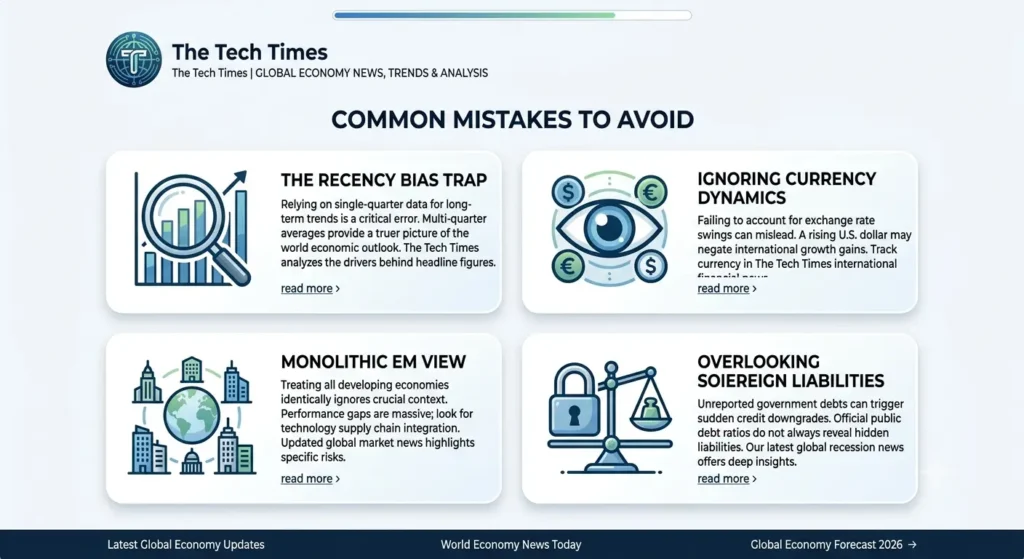
- Ignoring Currency Dynamics: Forgetting to factor in exchange rate fluctuations when reading international growth figures. A rising U.S. dollar can quickly wipe out nominal gains made in emerging market currencies.
- Treating Developing Markets as a Monolith: Assuming all emerging economies perform identically. The current world economic outlook shows a massive performance gap between nations deeply integrated into the tech supply chain and those relying on traditional commodities.
- Overlooking Hidden Sovereign Liabilities: Relying only on official, public debt-to-GDP ratios. Unreported government liabilities can trigger sudden credit downgrades that catch casual observers off guard.
Future Trends and Predictions: Global Economy Forecast 2026
The second half of 2026 is shaping up to be a delicate balancing act for the international financial system. According to the updated July world economic outlook from the IMF, global economic expansion is projected to slow to 3.0% in 2026 before recovering slightly to 3.4% in 2027. This modest deceleration stems from sticky headline inflation alongside higher energy prices driven by ongoing geopolitical conflicts.
[Global GDP Growth Projections]
   ├── 2024-2025 Average: 3.5%
   ├── 2026 Forecast:     3.0%  <-- Current Cyclical Cooldown
   └── 2027 Forecast:     3.4%
Fortunately, the rapid roll-out of artificial intelligence applications is helping cushion this slowdown. The ongoing technology investment boom is generating strong productivity gains, especially for advanced electronics exporters in East Asia.
Concurrently, global recession news continues to monitor core vulnerabilities in European consumer markets and highly indebted developing economies. Headline inflation across the globe is expected to tick up to 4.7% this year before dropping back to 3.9% in 2027. This trajectory forces central banks to keep interest rates higher for longer, reducing the likelihood of aggressive monetary easing in the near term.
Frequently Asked Questions
What are the primary drivers of the global economy forecast 2026?
The global economy forecast for 2026 is primarily shaped by two opposing forces: geopolitical tensions in the Middle East, which create energy shocks, and the massive global investment cycle in artificial intelligence hardware. These opposing trends are creating uneven growth across different regions.
Why is the current world economic outlook so uneven across different countries?
The current world economic outlook shows an expanding gap between nations deeply embedded in the technology supply chain and those dependent on traditional manufacturing or energy imports. Countries exporting advanced semiconductors are seeing solid growth, while energy importers face higher costs and slower growth.
Where can I find reliable, real-time international financial news?
For dependable insights, readers look to established financial institutions like the IMF and World Bank, alongside dedicated macroeconomic analytical platforms like The Tech Times. We combine raw financial data with a focus on how tech innovation drives modern economic trends.
Is there immediate risk in the latest global recession news?
While a widespread global collapse is not the baseline forecast, global recession news emphasizes real vulnerabilities in specific regions. High sovereign debt levels, elevated interest rates, and low consumer confidence continue to weigh heavily on parts of the Eurozone and heavily indebted developing countries.
How do global economic updates help individual retail investors?
Regular global economic updates help retail investors understand major macroeconomic trends, such as shifting inflation rates and central bank policies. This perspective allows investors to adjust their portfolios ahead of time, balancing their exposure between international equities, bonds, and stable commodities.
What impact does technology have on world economy news today?
Technology is a cornerstone of world economy news today. The global push to build out AI data centers and upgrade communication networks has created a powerful investment cycle, helping sustain international trade volumes even during periods of increased tariff barriers.
Why do changes in global market news affect everyday consumer pricing?
The modern production landscape is completely international. When global market news reports on currency swings, ocean freight bottlenecks, or rising energy costs, those wholesale expenses are eventually passed down to consumers, directly affecting retail prices for everything from electronics to groceries.
What should businesses watch for in upcoming global economy news?
Businesses should keep a close eye on central bank interest rate decisions, wholesale inventory trends, and changes to international trade tariffs. Staying on top of these indicators through platforms like The Tech Times allows companies to adjust their sourcing strategies and maintain healthy profit margins.
Final Thoughts
The global financial system in 2026 is a complex mix of geopolitical challenges and rapid, technology-driven innovation. Navigating this environment requires consistent attention to shifting trends and reliable analysis. Relying on outdated economic assumptions can leave your business or portfolio exposed to unexpected market shifts.
By tracking global economy news through dedicated platforms like The Tech Times, you gain access to the data, expert context, and deep analysis required to make sense of this changing landscape. As we look closely at the world economic outlook for the remainder of the year, staying informed is your best asset for managing risk and finding new opportunities. Keep following The Tech Times for clear, actionable macroeconomic insights that help you stay ahead of the curve.
About The Author
